
Is My Baby Hearing Me?
May 6, 2026
Summer Heat, Hydration & Sun Safety for Babies and Toddlers
July 6, 2026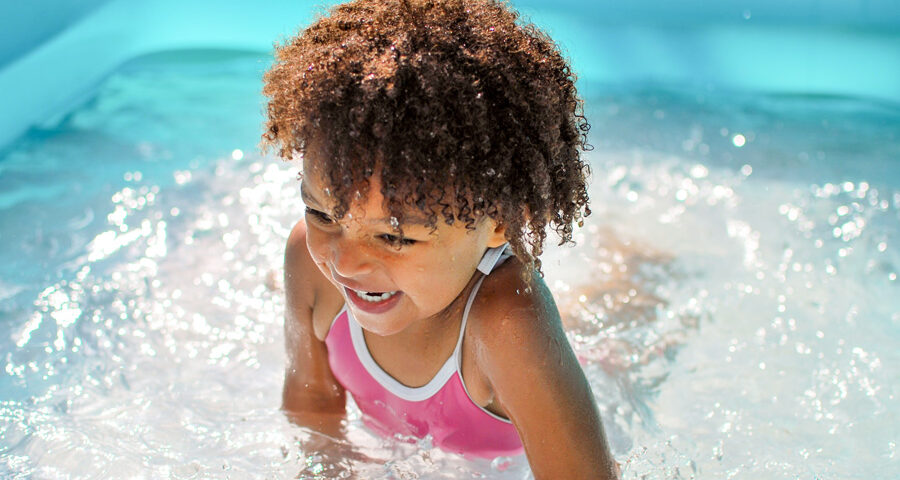
Splash, Play, and Grow:
How Water Play Builds Your Child’s Development—and How to Keep Them Safe This Summer
Who hasn’t seen their toddler splashing in a puddle after a summer rain?
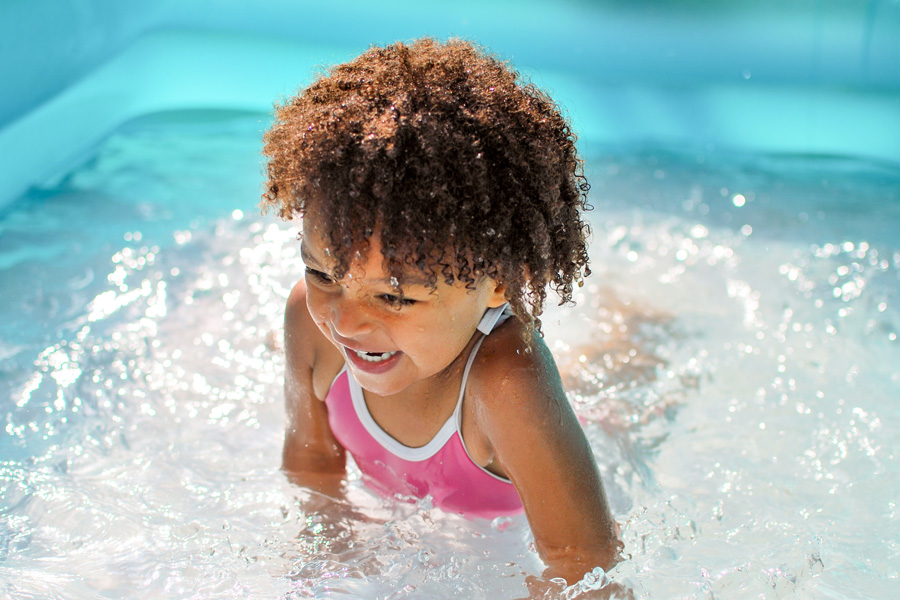
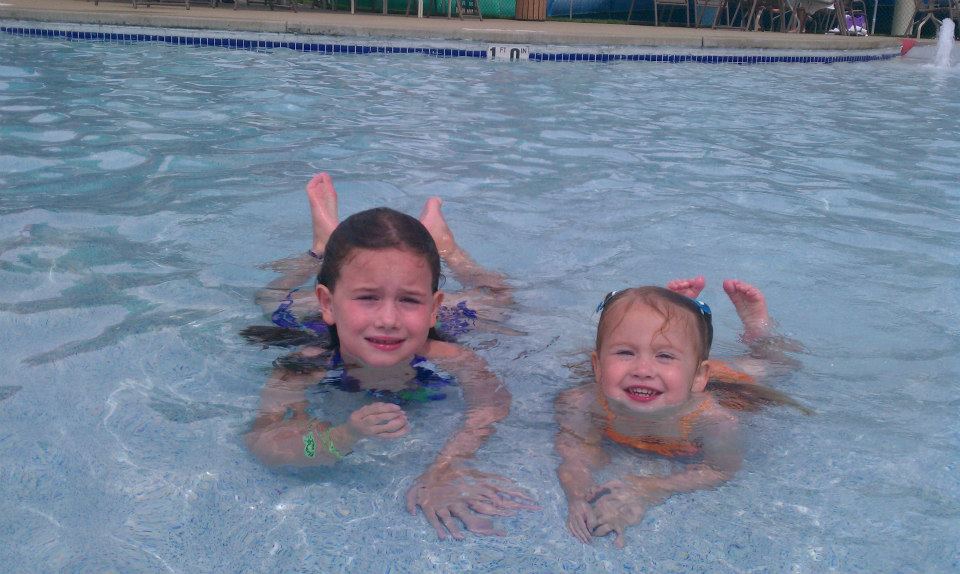
When the weather warms up, water becomes one of the richest play environments a young child can experience. For children ages 0 to 3, a backyard sprinkler, a shallow wading pool, a bucket of soapy water, or even bath time turns into a hands-on lesson in movement, sensation, and discovery.
For parents looking for outdoor play activities, water can be an amazing resource. It surrounds your child in a whole new kind of feedback. Water is cool, slippery, and full of resistance, and that engages several areas of development at once. Your child isn’t just getting wet. He or she is building muscles, testing ideas, and picking up new words, all while having a blast.
In this article, we’ll look at how water play naturally supports four key areas of growth: sensory processing, gross motor skills, fine motor skills, and early thinking and language. The setups stay simple, free, and easy, the kind you can put together with what you already have at home.
Then, because water deserves respect, we’ll take a look at practical safety guidance you can use all summer long. The goal isn’t to make you nervous. It’s to help your family feel confident, so water stays safe and fun
Why Water Play Is Such Powerful Learning
According to Pathways.org, water play is like giving your child a brand-new playground where even simple movements become a fresh sensory experience. It takes more muscle to move an arm or a leg through water than through air, so reaching, kicking, and splashing all work like gentle strength and balance training.
Water responds to everything your child does. It ripples, splashes, and pours, delivering satisfying feedback that keeps little ones curious and engaged.
Sensory Processing: A Whole New World of Feedback
Water can be a full-body sensory experience. The sound of a hose or sprinkler, the cooling, wet splash on a hot day, the dazzle of sunlight through the droplets, and that special smell of wet grass and soil— all of it gives your child’s growing nervous system rich information to sort through. Learning to notice, interpret, and respond to these sensations is a real developmental skill, and water play gives plenty of practice.
Children also learn the contrast between wet and dry, full and empty, cold and warm. These everyday comparisons help your child’s brain organize the world. It sounds simple, but it’s the same kind of sorting that supports later learning.
What you can do: Offer a variety of textures and temperatures. Try a bin with warm water and a few floating sponges, or set out one cup of cool water and one of lukewarm so your child can feel the difference. Add bubbles for a slippery surprise. Narrate what he or she is feeling as you go: “Ooh, that’s cold!” or “The sponge is so soft and squishy.”
Gross Motor Skills: Moving Against the Water
If you have access to a kiddie pool, then kicking, reaching, splashing, and squatting to scoop all become a workout in water. Because water pushes back, your child’s muscles work harder than they would otherwise. Kicking engages the core, and moving through water helps your child learn to coordinate muscles in a way that supports crawling, walking, and climbing.
For babies, supervised splashing during a shallow, supported sit builds head and trunk control. For toddlers, walking through ankle-deep water or stepping in and out of a wading pool challenges balance in a forgiving setting where a wobble ends in a splash, not a scrape.
What you can do: Set up a shallow wading pool that is appropriate and safe for your child’s height. Encourage big movements like stomping, kicking, and reaching for floating toys just out of reach. For little ones, let your baby splash with hands and feet while you provide steady support. Always stay within arm’s reach (more on that below).
Fine Motor Skills: Pouring, Squeezing, and Scooping
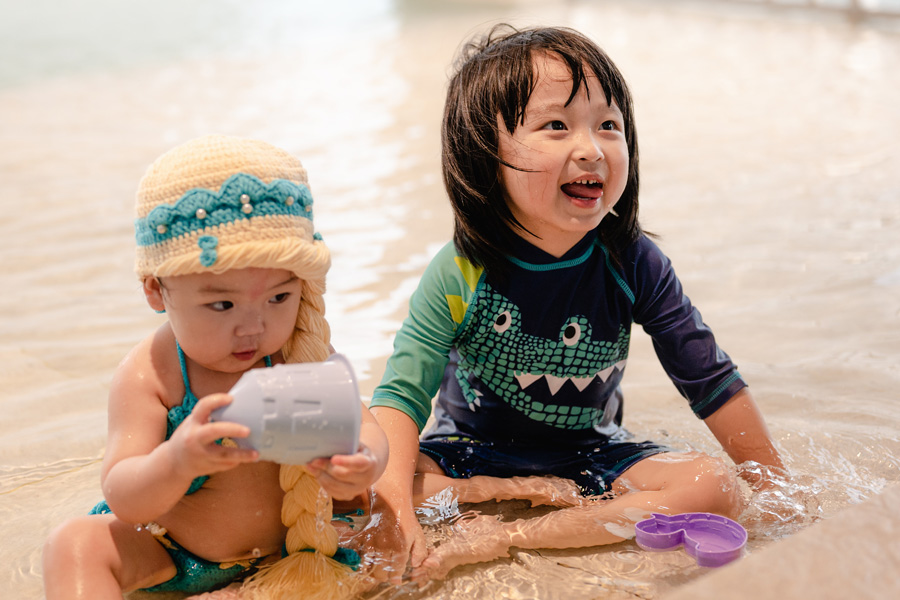
Water is a natural invitation for the small, precise movements that build fine motor strength. Pouring water from one cup to another takes wrist control and hand-eye coordination. Squeezing a sponge strengthens the same little hand muscles your child will one day use to hold a crayon or fasten a button. Filling and dumping containers teaches grip, release, and a surprising amount of patience.
The good news is you don’t need special toys. Measuring cups, a turkey baster, empty squeeze bottles, a colander, and a few plastic containers from the kitchen are perfect.
What you can do: Gather a few safe containers in different sizes and let your child pour, scoop, and transfer water between them. Offer sponges to squeeze and squirt bottles to press. For older toddlers, drop in a few small floating toys to fish out, which builds the pincer grasp, the thumb-and-finger pinch that’s so important for later skills.
Early Thinking and Language: Cause, Effect, and New Words
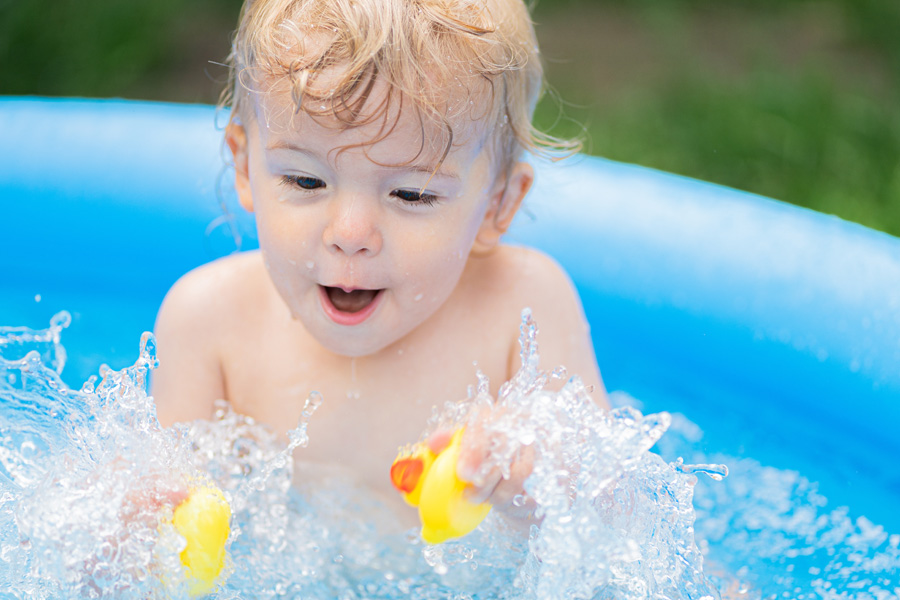
Every splash is a tiny science experiment. When your child slaps the surface and water flies up, or pushes a cup under and watches the bubbles rise, he or she is learning cause and effect. Why do some toys float while others sink? What happens when you pour fast versus slow? These are early reasoning skills in action.
As you play together, you naturally model words like splash, pour, slippery, cold, wet, float, and empty. Talking through what’s happening—“You filled the cup all the way up!”—connects words to real experiences, which is exactly how young children build vocabulary.
What you can do: Talk. It’s that easy. Name what your child is doing and seeing, and ask simple questions: “What will happen if we drop the rock in?” Pause and give your child time to respond, whether with words, sounds, or a delighted look. Try a simple float-or-sink game with a few household objects to spark curiosity and conversation.
Water Safety Every Parent Should Know
As much fun as splashing around in water can be, safety is the most important part. The American Academy of Pediatrics and the CDC note that drowning is the leading cause of injury-related death for children ages 1 to 4. It can happen in seconds and almost silently, and being on the alert is critical to staying safe this summer.
The AAP recommends thinking about water safety as layers of protection where several safeguards work together to create a strong safety net:
- Practice “touch supervision.” Whenever a young child is in or near water, a responsible adult should stay within arm’s reach—close enough to touch. Put the phone away and avoid distractions. When several adults are around, name one “water watcher” whose only job is watching, then trade off.
- Empty water right after use. Children can drown in just an inch or two of water. Dump out tubs, buckets, wading pools, and water tables as soon as play is over, and store them upside down so they can’t collect rainwater.
- Put up barriers. If you have a home pool and a toddler is present, surround the pool with a four-sided fence at least four feet high that has a self-closing, self-latching gate. Use locks or alarms on doors that lead to water.
- Stay close at bath time. Never leave a baby or toddler alone in the bath, even for a moment, and even in a bath seat. If you have to step away, take your child with you.
As your child grows, the CDC also offers helpful, age-appropriate summer swim safety tips. Learning CPR is another powerful layer—one more way to feel ready.
A Few Things to Watch For
Water play can also offer little windows into how your child is developing. Most of the time, what you’ll see is pure joy. But now and then, water play can gently surface something worth keeping an eye on. Think of these as prompts to check in, not reasons to worry:
- Your child consistently avoids or seems distressed by water textures, splashing, or getting his or her hands wet.
- Your child shows unusual difficulty with the kinds of coordination water play includes (reaching, scooping, kicking, or balancing) compared with other children around the same age.
- Your child doesn’t seem to connect actions with their results (splash, pour, sink) in the playful, curious way you’d expect by his or her age.
Every child is different, and a single observation rarely means much on its own. But if a pattern keeps showing up, it’s worth a conversation.
When to Seek Support
Trust your instincts. You know your child best. If something about your child’s movement, sensory responses, or communication doesn’t feel right, there’s never any harm in asking questions. Consider reaching out to your pediatrician or early intervention team if you notice:
- Strong, ongoing distress around common sensations like water, textures, or sounds
- Noticeable delays or difficulty with motor skills such as sitting, reaching, crawling, or walking
- Few words, sounds, or gestures to communicate compared with what’s typical for your child’s age
- A loss of skills your child had previously gained
Early support makes a real difference, and getting answers brings peace of mind.
Early Intervention Therapies
If you have questions about your child’s development, TEIS Early Intervention can help. Our specialists listen to your concerns, assess your child’s individual needs, develop a customized treatment plan, and coach you through simple, routine-based solutions to help your child thrive.
Call us at 412-271-8347 or ask your pediatrician about getting an Early Intervention evaluation.
Early intervention evaluations and therapy services are available under the Federal Early Intervention Program for Infants and Toddlers with Disabilities. Before services can begin, an independent evaluation of your child must be completed. To ensure impartiality, one agency provides evaluation services while another offers therapeutic services.
To schedule an evaluation, call 1-800-692-7288 or email help@connectpa.net
 Send to a friend!