First Steps and Gross Motor Milestones from Birth to Age 3
September 11, 2026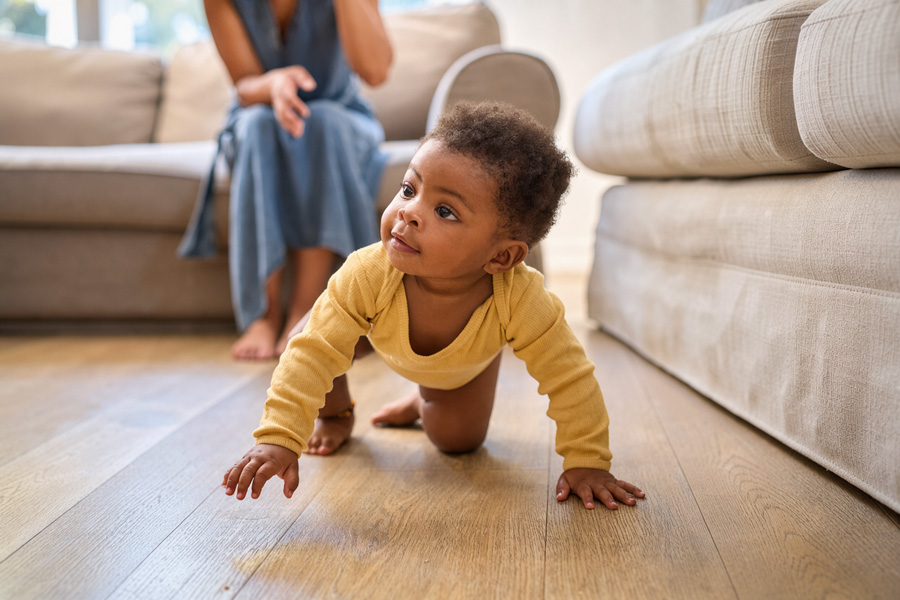
Not on the Milestone Checklist. Still on the Treatment Plan.
Crawling came off the CDC’s developmental milestone checklists in 2022, and that might lead some to think it’s not that important as a milestone. But parents know those first crawls are almost as exciting as baby’s first steps.
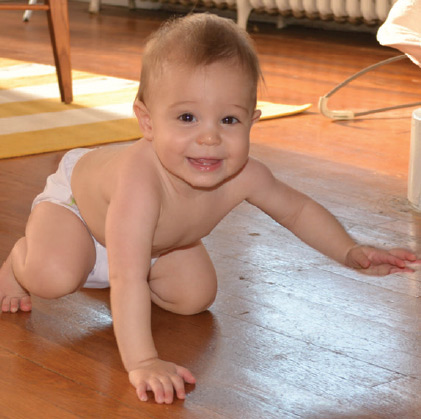
Of course, crawling is important. It asks more of a baby’s body than almost anything else in the first year. Arms and shoulders carry weight. Opposite arms and legs take turns. The trunk holds steady while everything else moves. And for most babies, crawling is the first time he or she can pick a destination and get there alone.
That’s why our physical and occupational therapists still encourage and facilitate crawling, and why it’s a goal we write into treatment plans regularly. In this article we’ll look at crawling styles, simple ways to help, and when it’s worth asking your pediatrician for guidance.
Why Is Crawling No Longer a Milestone?
When the CDC and the American Academy of Pediatrics updated their developmental milestone checklists, crawling was left off. That wasn’t a judgment that crawling doesn’t matter. It was a decision about screening: crawling is just too broad a skill with too much timing difference from child to child to serve as a reliable warning sign.
The updated checklists include only skills that at least 75% of children have reached by a given age. Some babies crawl at seven months, some at ten. Some belly crawl for weeks, and some skip straight to pulling up. A skill that varies that much doesn’t make a good warning sign by itself. That’s the logic of a checklist and a screening tool; it’s not a ranking of what’s valuable.
And not everyone agrees. It turns out pediatric physical therapists noticed the change, and most of them disagreed with it. In a national survey of 420 pediatric PTs published in 2024 in the journal Pediatric Physical Therapy, 92% said crawling on hands and knees is important for development, and 79% disagreed with removing it from the CDC checklists. One of the study’s co-authors, Dr. Regina Harbourne, was with Duquesne University’s physical therapy department, right here in Pittsburgh.
The same researchers are candid that the science is still catching up with what therapists see every day. Much of the research on early movement looks at independent mobility in general, and for most babies, crawling is where independent mobility begins.
What Does Crawling Do for Your Baby’s Development?
Crawling strengthens the shoulders, arms, and trunk, prepares the hands for later fine motor skills, trains both sides of the body to work together, and gives the eyes practice shifting between near and far. In that same survey mentioned above, the large majority of pediatric PTs (in the high end of the 71%–99% range reported for specific outcomes) agreed that crawling contributes to upper body and shoulder strength.
Strong Shoulders, Ready Hands
Crawling is the one stretch of early life when a baby routinely carries his or her own body weight. That pressure builds stability in the shoulders, stretches the wrists back, and helps shape the small arches in the palm. Those arches are what later let a hand cup a crayon, steer a spoon, or work a button. Our occupational therapists pay close attention to this, and Pathways.org makes the same connection, noting that crawling builds the hand strength and shoulder stability a baby will need to feed himself or herself.
Both Sides, Taking Turns
The classic hands-and-knees crawl is a cross-body rhythm: left hand and right knee, then right hand and left knee, over and over. Crawling is one of the first motor activities that gets both sides of the body, and both sides of the brain, working together. That same back-and-forth coordination turns up again in walking, climbing stairs, and eventually pedaling a tricycle.
A Steady Middle
While four limbs take turns leaving the floor, the belly and back muscles have to hold the middle steady. It’s harder than it looks, and that’s why baby’s first crawls often collapse after a few “steps.” That core stability is literally the foundation for steady sitting, standing, and walking.
Eyes Up, Eyes Down, and New Surfaces
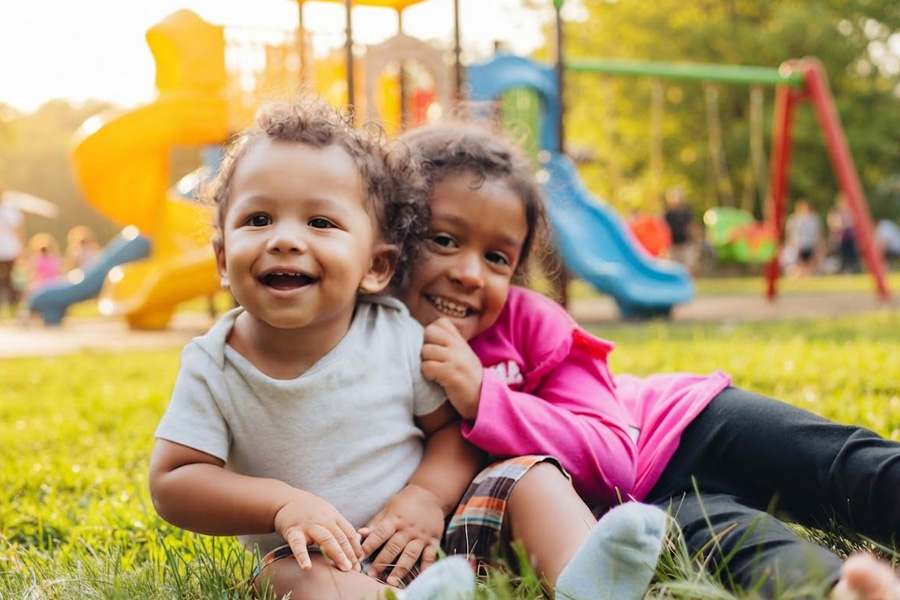
A crawling baby looks down at the floor just ahead of his or her hands, then up at the toy across the room, then down again. That near-to-far shifting is good practice for the eyes. Meanwhile, every new surface sends new information through the hands and knees: carpet, hardwood, a quilt, and, when the weather permits, outdoor activities in the grass and leaves of parks and back yards.
What Else Changes When Crawling?
Researchers who study babies before and after they start moving on their own have found changes in spatial memory, in following a parent’s gaze and pointing finger, and in checking a parent’s face before trying something new. For most babies, crawling is where that independence starts.
A landmark review of this research, titled “Travel Broadens the Mind,” pulled these findings together. The key idea is getting around under one’s own power, and crawling is often the first experience in this direction.
There’s also a lovely finding from studies that fitted babies with tiny head-mounted cameras. Crawling babies and walking babies literally see different worlds. Down on hands and knees, the view is mostly floor and whatever is on it. Upright, it’s the room and the faces in it. Both views teach new skills and broaden baby’s internal map and understanding of the world.
Many parents notice the shift at home, too: more testing of limits and a lot more “no” from you. That’s development, not defiance.
Which Crawling Styles Are Normal?
The American Academy of Pediatrics recognizes six common crawling styles, and any of them can get a baby across the room. What therapists watch more closely is how a baby moves: whether both sides of the body share the work, and whether the style keeps progressing over time.
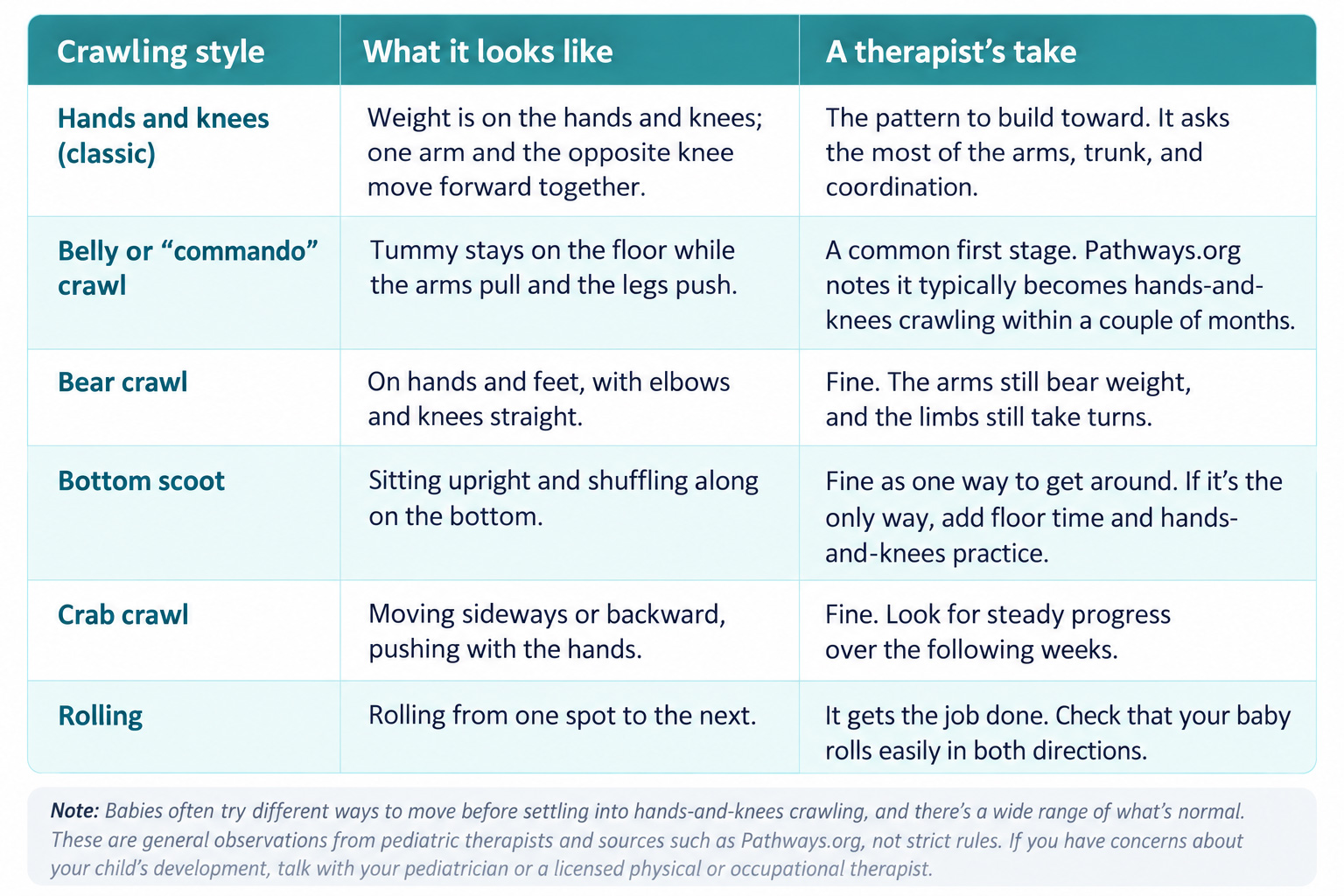
One important note on scooting: some parents discourage it, but that is not necessary. If your baby has found a way to get around, that independence is valuable. The goal is to add hands-and-knees practice, not to discourage a natural way to get around.
The Pattern That Matters Most: Is One Side Doing All the Work?
When it comes to identifying potential problems, asymmetry in movement is more important than any particular crawling style. A baby who drags one leg every time, pushes with one arm while tucking the other, or always turns the head the same direction is worth a closer look. Persistent head-turning can point to torticollis, and a baby who seems unusually floppy may have low muscle tone. Both respond well to early physical therapy.
How Can I Encourage My Baby to Crawl?
Give your baby plenty of floor time, a reason to move, and someone to copy. Most of what helps costs nothing: a safe stretch of floor, a favorite toy just out of reach, and a parent willing to get down there too.
What you can do:
- Start with tummy time. Everything crawling asks for gets built face-down on the floor first. Our September 2026 post on gross motor milestones covers how much tummy time babies need and how to make it easier.
- Place toys to the side, not just ahead. A toy set off to one side encourages your baby to pivot on his or her tummy, which is often the first crawling-like movement you’ll see. Switch sides next time.
- Practice rocking on all fours. Once your baby can push up on straight arms, help him or her onto hands and knees and let the rocking happen. Babies learn to balance in a position before they move out of it.
- Crawl with your baby. Get down on the floor and show how it’s done. It’s the cheapest intervention there is, and babies love the company.
- Try a supervised stair climb. Crawling up two or three carpeted steps lifts the belly off the floor and encourages alternating arms and legs. Stay right behind your baby, every time.
- Mix up the surfaces. Carpet, hardwood, a blanket, the yard. Different textures, different feedback.
- Keep container time short. Bouncers, jumpers, swings, and seats all subtract from floor time. And skip wheeled baby walkers entirely; the AAP has called for a ban on them.
- Baby-proof at baby height. Get down on your hands and knees and look around. Anchor furniture, cover outlets, gate the stairs, and pick up anything small enough to swallow. Once your baby crawls, the room belongs to him or her.
Crawling Doesn’t Expire at 12 Months
Hands-and-knees play keeps helping baby develop even after the first year. Games that put weight back through the arms and hands build shoulder stability and hand strength well past the first birthday, and occupational therapists use them on purpose with toddlers who need extra help in those areas.
Try bear walks and crab walks across the living room, a tunnel made from a row of kitchen chairs, a couch-cushion obstacle course, or a game of chase where everyone has to stay on all fours. For a two-year-old with weak shoulders or tired hands, these games are therapy. For everyone else, they’re a good rainy day afternoon.
When Should I Worry That My Baby Isn’t Crawling?
Pathways.org recommends asking a healthcare provider if your baby isn’t motivated to crawl or is having trouble with crawling by about 10 months. That doesn’t mean something is wrong. It means it’s a good time for a professional look. Along with timing, watch for these patterns:
- One side doing the work. Dragging one leg, favoring one arm, or always turning the same way.
- Trouble taking weight on the arms. Collapsing onto the floor when placed on hands and knees, or not pushing up on straight arms during tummy time.
- No progress. Staying on the belly or bottom for months with no movement toward hands and knees or pulling up.
- Muscle tone that seems off. Persistently stiff, or persistently floppy.
- Losing a skill. If your baby could do something and now can’t, call your pediatrician. This is never a wait-and-see.
A good rule of thumb for parents is this: you don’t need a missed milestone to ask for help. If your baby isn’t crawling and you’d like help getting there, that’s a perfectly reasonable thing to bring to your pediatrician.
Frequently Asked Questions
When do babies start crawling?
Belly crawling usually begins around 7 to 9 months, and many babies move up to hands and knees within a couple of months after that, according to Pathways.org. The normal range is wide. Babies born early are usually measured by their corrected age, so a baby born two months early may crawl on a timeline closer to a baby two months younger.
Why isn’t crawling a CDC milestone anymore?
The CDC’s updated checklists only include skills that at least 75% of children reach by a given age, so a missed item is a clearer signal. Crawling varies too much in timing and form to meet that bar. It was removed as a screening item, not because experts decided it doesn’t matter.
Does it matter if my baby skips crawling?
Not necessarily. If your baby skipped crawling but uses both sides of the body evenly and keeps gaining new skills, there’s usually no cause for alarm. You can still give your child plenty of hands-and-knees play through the toddler games above. If something else about the way your child moves concerns you, ask.
My baby army crawls. Should I try to change it?
There’s no need to stop it. Belly crawling is a common stage, and it still gets your baby moving. You can help him or her build toward hands and knees with tummy time, rocking on all fours, and a little supervised stair practice. If your baby is still belly crawling a couple of months later with no progress, or always pulls with the same arm, mention it to your pediatrician.
Can early intervention help a baby learn to crawl?
Yes. Physical and occupational therapists help babies build the strength, balance, and coordination crawling requires, and they coach parents on ways to practice during everyday routines. An evaluation determines whether your child qualifies for services, and you can request one yourself, without a doctor’s referral.
Early Intervention Therapies
You know your baby better than anyone. If something about the way he or she moves doesn’t sit right with you, that’s reason enough to ask.
TEIS Early Intervention can help. Our specialists listen to your concerns, assess your child’s individual needs, develop a customized treatment plan, and coach you through simple, routine-based ways to help your child thrive. Learn more about our physical therapy services and occupational therapy services for children ages 0 to 3.
“We have absolutely loved our experience with TEIS. Our son was having trouble crawling (and later walking) and needed PT services due to low tone.” — Sarah S., TEIS parent
Call us at 412-271-8347 or ask your pediatrician about getting an Early Intervention evaluation.
Early intervention evaluations and therapy services are available under the Federal Early Intervention Program for Infants and Toddlers with Disabilities. Before services can begin, an independent evaluation of your child must be completed. To ensure impartiality, one agency provides evaluation services while another offers therapeutic services.
To schedule an evaluation, call 1-800-692-7288 or email help@connectpa.net.
 Send to a friend!