

Why Crawling Is Important: Skills Built on Hands and Knees
October 6, 2026
Why Your Baby Has Two Birthdays
Your preemie has two birthdays: the day they were born, and the day they were due. When it comes to developmental milestones, the due date usually matters more. It’s the key to your baby’s corrected age and the date you should use when thinking about milestones.
November is Prematurity Awareness Month, and November 17 is World Prematurity Day. Here in Allegheny County, about one baby in ten arrives before 37 weeks. The March of Dimes 2025 Report Card puts the county’s preterm birth rate at 10.4%, above Pennsylvania’s 9.8%.
If your family is part of that number, this guide is for you.
What Is Corrected Age for a Premature Baby?
Corrected age, also called adjusted age, is your baby’s age counted from the due date instead of the birth date. You find it by subtracting the number of weeks your baby arrived early from his or her actual age in weeks. Until about age 2, it gives a fairer picture of development than the calendar does.
Pathways.org adds some categories: extremely preterm (before 28 weeks), very preterm (28–31 weeks), moderately preterm (32–33 weeks), and late preterm (34–36 weeks).
Here’s how to do the math:
- Subtract your baby’s weeks at birth from 40. That’s how many weeks early he or she arrived.
- Count your baby’s actual age in weeks since the birth date.
- Subtract the first number from the second. That’s corrected age.
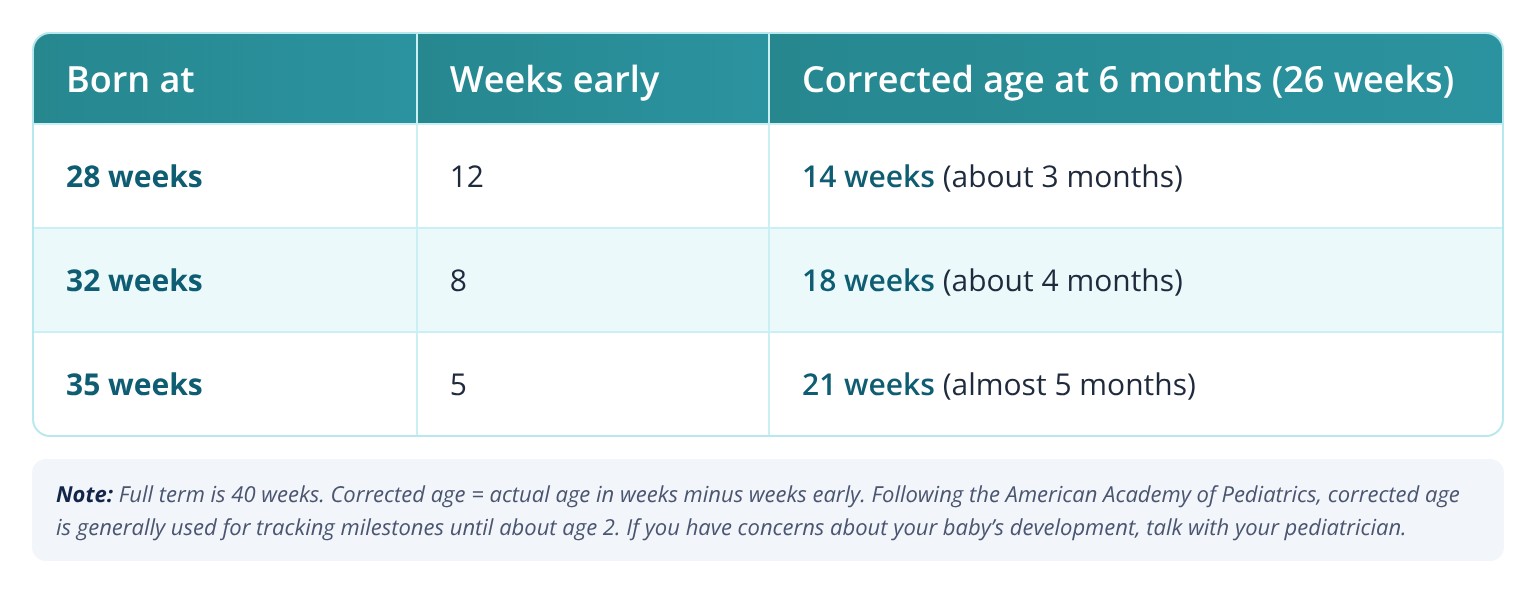
The American Academy of Pediatrics offers a simple example: a baby born at 32 weeks is 8 weeks early, so at 4 months old she is compared with a 2-month-old born on time. Here’s how it works for three babies who are all 6 months old today:
Why Does My Preemie Seem Behind?
They may not be behind at all. For preemies this usually happens because you’re measuring by the calendar. A 6-month-old born 12 weeks early is doing 3-month-old work. Next to a full-term baby the same age, he or she may look behind. Measured by corrected age, he or she may be right on track.
Thanksgiving tends to bring this into focus. A table full of cousins invites comparisons, and a well-meaning relative may ask why your baby isn’t sitting up yet. Corrected age is your answer. (Our post on communication milestones and the holidays has more on how to handle these often well-meaning comments.)
According to the AAP, corrected age is generally used for developmental monitoring until about age 2, by which time many preemies have caught up to the typical ranges. Catch-up varies by how early the baby was born and is not guaranteed for every milestone, so those who haven’t caught up may simply need support a little longer.
How to Use Corrected Age with Milestone Checklists
When you have a preemie, it’s best to read every milestone list through the lens of corrected age. The CDC’s milestone checklists list skills by fixed ages and don’t mention prematurity, so the translation is up to you. If your baby is 9 months old but 6 months corrected, start with the 6-month list.
The same goes for our Milestone Meter quizzes and our recent posts on gross motor milestones and crawling. Choose the age band that matches corrected age instead of your baby’s actual birthday.
When Preemies Need a Little Extra Help
Most preemies catch up, and many who do need early intervention only need it for a while. Still, arriving early can affect muscle tone, feeding, the senses, and vision, so some babies benefit from a short-term boost of therapy. Here’s what our therapists often watch for:
- Muscle tone and positioning. Tone that seems stiff or floppy, or a baby who arches. Long stretches in one position can also contribute to torticollis. Our physical therapists help with both.
- Feeding. Coordinating suck, swallow, and breathe can take preemies extra time. Occupational therapy and feeding support and nutrition therapy can help.
- The senses. Preemies spend key weeks of brain development amid NICU light and sound. A 2015 review in the American Journal of Occupational Therapy found sensory processing differences are common in children under 3 who were born preterm. An occupational therapist can support sensory development early.
- Vision. Babies born before 30–31 weeks or under 1,500 grams (about 3 lbs 5 oz) are at higher risk for retinopathy of prematurity, according to Prevent Blindness and standard screening guidelines. Keep every recommended follow-up eye exam. Learn more about our vision services.
- Supporting You. Our social workers support the whole family.
What You Can Do
- Do the math once and write down corrected age and due date for every appointment.
- Plan daily floor time and tummy time around corrected age.
- Learn your baby’s cues. Our Transitioning Home for Premature Babies fact sheet covers cues and positioning.
- Keep every follow-up: well visits, NICU follow-up clinic, and eye exams.
- Share corrected age with grandparents and child care staff.
- Don’t let corrected age become a reason to wait for assistance. It explains a gap. It doesn’t mean you have to wait to ask for help when you feel there might be a problem.
When to Ask for Help
Talk with your pediatrician if you notice:
- No progress from one skill to the next, even by corrected age. One example is pulling up, then standing, then walking.
- Excessive crying, tremors, or startles around 1 month corrected.
- Tone that stays stiff or floppy, or a strong preference for one side.
- Feeding that stays hard work for your baby or your family.
- Losing a skill your baby already had. That’s never a wait-and-see.
And trust your instincts. You know your baby best.
Early Intervention for Preemies in Pennsylvania
Your baby doesn’t need a diagnosed delay to get on Pennsylvania’s radar. Some babies can be enrolled in developmental monitoring, often called at-risk tracking, which checks development regularly over time. In Allegheny County, babies born under 1,500 grams (3 lbs. 5 oz.) and babies cared for in a NICU are among the groups who qualify for tracking.
Children qualify for early intervention services with a developmental delay, a diagnosed condition likely to lead to one, or the informed opinion of a trained clinician. To ask about tracking or an evaluation in any county, call CONNECT at 1-800-692-7288.
A Few FAQs
Is adjusted age the same as corrected age?
Yes. Both terms mean your baby’s age counted from the due date. You may see either one on forms, in apps, and in our own materials.
What happens after age 2?
Milestones are generally tracked by actual age, according to Pathways.org. Babies born a few weeks early still deserve attention. A Michigan Medicine study found late preterm children on track at 2, but with small differences in early reading and math by preschool and kindergarten. Reading and counting together at home helps.
Does a baby born at 36 weeks need corrected age?
Yes. Corrected age applies to any baby born before 37 weeks and is generally used until age 2. Four weeks early is nearly half of a 2-month-old’s life, so it matters most in the early months.
Early Intervention Therapies
If you have questions about your preemie’s development, TEIS Early Intervention can help. Our developmental therapists and specialists listen to your concerns, assess your child’s needs, and coach you through simple, routine-based strategies.
Call us at 412-271-8347 or ask your pediatrician about an Early Intervention evaluation.
Early intervention evaluations and therapy services are available under the Federal Early Intervention Program for Infants and Toddlers with Disabilities. Before services can begin, an independent evaluation of your child must be completed. To ensure impartiality, one agency provides evaluation services while another offers therapeutic services. If your child qualifies, you can choose TEIS as your provider.
To schedule an evaluation, call 1-800-692-7288 or email help@connectpa.net.
 Send to a friend!