
Sleep and Childhood Development: What Parents Should Know
February 9, 2026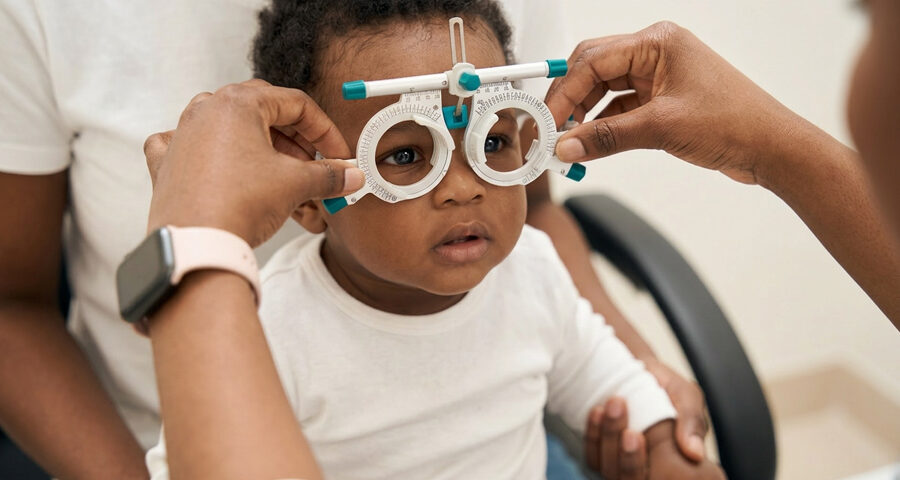
The way your toddler reaches for a favorite toy. The excitement in their eyes when they spot you across the room. Even your baby’s first smile. So much of how your child connects with the world starts with vision.
But here’s something you may not know: babies aren’t born seeing clearly. Just like learning to walk and talk, learning to see is a process that develops over time. And unlike a late first word or a delayed first step, vision problems in young children often go unnoticed, because your child can’t tell you they’re having trouble seeing.
Until they get a bit older, recognizing vision problems in your toddler is up to you. But don’t stress. When you know what to look for, you can support your child’s visual development. First, we’ll explore how vision develops in children from birth to age 3, then we’ll go over what warning signs to watch for, and finally we’ll talk about when it’s time to seek help.
Why Vision Matters for Early Development
Vision is the foundation for many of the skills your child is building every day. According to the American Optometric Association, healthy eyes and good vision play a critical role in how infants and children learn to see and see to learn.
Think about it this way. Before your baby can reach for a rattle, they need to see it. Before they can crawl toward a ball, they need depth perception to judge how far away it is. Before they can recognize your face and smile back, their visual system needs to be working together with their brain.
Vision supports:
- Hand-eye coordination – reaching, grasping, and eventually stacking blocks or holding a crayon
- Depth perception – judging distance for crawling, walking, and climbing
- Face recognition and social bonding – reading expressions, making eye contact, and connecting with caregivers
- Exploration and learning – making sense of objects, spaces, and the world around them
When vision problems go undetected, they can ripple into other areas of development. Children may fall behind in motor skills, struggle with social interaction, or have a harder time with early communication and language. That’s why catching vision problems early makes such a difference.
When to Get Your Child’s First Eye Exam
Many parents assume that if their pediatrician doesn’t mention a vision concern, everything must be fine. And most of the time that is true. But a standard checkup doesn’t replace a comprehensive eye exam.
The American Optometric Association recommends that babies have their first thorough eye exam at about 6 months of age, even if no problems are apparent. Your eye doctor can test for nearsightedness, farsightedness, astigmatism, eye movement, and eye alignment.
The American Academy of Pediatrics recommends that vision assessment begin at birth and continue as part of routine well-child visits. Early identification through screening can reduce certain causes of vision loss, such as amblyopia (sometimes called “lazy eye”), by up to half.
If your family has a history of childhood eye problems, premature birth, or developmental delays, it’s especially important to schedule that first exam early. Through the InfantSEE program, participating eye doctors provide a free comprehensive infant eye assessment between 6 and 12 months of age.
Vision Milestones by Age
Your child’s visual abilities develop in stages. Here’s what to expect and what to watch for at each age:
Birth to 4 Months
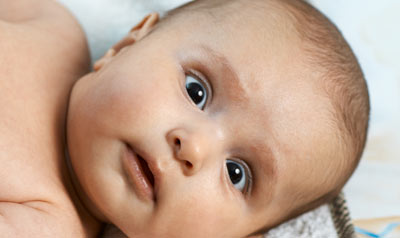
At birth, your baby’s world is blurry. They see best at about 8 to 10 inches away (roughly the distance to your face during feeding). High-contrast patterns, like black and white images, catch their attention more easily than colors at this stage.
During these first months, your baby’s eyes are learning to work together. You may notice their eyes wander or even appear crossed from time to time. This is usually normal during the first few months. By about 8 weeks, your baby should begin focusing more easily on your face. By around 3 months, they should start following moving objects with their eyes (directed reaching often begins around this time or shortly after).
What you can do: Use a nightlight in the nursery, change your baby’s crib position regularly, and keep toys within 8 to 12 inches of their face. Talk to your baby while walking around the room to encourage them to track your voice and movement together.
5 to 8 Months
This is when vision really starts coming together. Around 5 months, your baby’s eyes are finally able to create a three-dimensional view of the world. Depth perception—the ability to judge whether objects are near or far—begins to develop.
Color vision also improves during this time. By 5 months, most babies have good color vision, though it’s not quite as sharp as an adult’s. You’ll notice your baby becoming more interested in brightly colored toys and objects.
Most babies start crawling around 8 months, and this is important for vision development too. Crawling helps strengthen eye-hand-foot-body coordination. Crawling helps strengthen eye-hand-foot-body coordination (many babies begin crawling between 6–10 months).
What you can do: Give your baby plenty of floor time to explore. Hang a mobile or provide toys they can grab and kick. Play patty-cake and other interactive games that encourage hand-eye coordination.
9 to 12 Months
By this age, your baby should be able to judge distances fairly well and throw things with reasonable accuracy. Around 9 months, most babies begin pulling themselves up to stand. By 10 months, they should be able to grasp small objects between their thumb and forefinger. Think about it. That’s a fine motor skill that depends heavily on vision.
What you can do: Play hide-and-seek with toys to build visual memory. Name objects while talking to encourage word association. Encourage crawling even if your child is ready to walk, because crawling continues to strengthen visual coordination.
1 to 3 Years
By age 2, your child’s hand-eye coordination and depth perception should be well developed. You’ll see them recognizing familiar objects and pictures in books, scribbling with crayons, and becoming much more confident exploring their surroundings.
Between ages 2 and 3, your child’s visual system gains some polishing. They’re getting better at focusing on small details, tracking fast-moving objects, and using their vision to guide increasingly complex movements.
What you can do: Roll a ball back and forth to encourage visual tracking. Provide building blocks and balls of different shapes and sizes. Read stories together to help develop the visual skills that will support future reading and learning.
Warning Signs Parents Can Watch for at Home
Most babies develop healthy vision without any problems. But because young children can’t describe what they’re seeing (or not seeing) it’s up to parents to watch for signs that something might need attention.
The American Optometric Association and Prevent Blindness recommend watching for these warning signs:
- Excessive tearing when your baby isn’t crying, which may indicate blocked tear ducts
- Red or crusted eyelids, which could be a sign of an eye infection
- Persistent eye turning or misalignment (one eye consistently turns in or out after 3 to 4 months of age), which may signal a problem with eye muscle control
- Extreme sensitivity to light, which can indicate elevated pressure in the eye
- A white or cloudy appearance in the pupil, which requires immediate medical attention
- Consistent head tilting or turning to look at things, which may mean one eye is working harder than the other
- Not following objects with their eyes by 3 to 4 months of age
- Squinting or closing one eye frequently, especially in bright light or when trying to focus
If you notice any of these signs, contact your pediatrician or eye care professional right away. Early detection is key, and most childhood vision problems respond well to treatment when caught early.
Vision and Developmental Delays
Vision doesn’t develop in isolation. It works hand in hand with motor skills, cognitive growth, social-emotional development, and even language. When a child has an undetected vision problem, the effects can show up in ways that don’t immediately point to the eyes.
A child who avoids tummy time or doesn’t reach for toys may not be “lazy” or “slow”—they may simply not be seeing the things that motivate those movements. A toddler who seems clumsy or bumps into furniture may be struggling with depth perception. A child who doesn’t make eye contact or respond to facial expressions might have trouble with visual processing rather than social engagement.
Research shows that vision problems in young children can contribute to delays in:
- Gross and fine motor skills – crawling, walking, grasping, and manipulating objects
- Cognitive development – learning through observation, imitation, and cause-and-effect exploration
- Social interaction – reading facial expressions, making eye contact, and engaging with others
- Language acquisition – watching lip movements and gestures that support early speech development
This is why vision services are such an important part of early intervention. When a vision issue is identified early and addressed through the right therapies, children often make significant progress in areas that seemed unrelated to their eyes.
When to Seek Support
Every child develops at their own pace, and there’s a wide range of normal when it comes to vision milestones. But if something about your child’s vision doesn’t seem right, trust your instincts. You know your child best.
Consider reaching out to your pediatrician or early intervention team if you notice:
- Your baby’s eyes consistently cross or turn after 3 to 4 months of age
- Your child doesn’t seem to follow objects or make eye contact by 3 to 4 months
- Your child frequently squints, tilts their head, or covers one eye
- You notice a white or unusual reflection in your child’s pupil, especially in photographs
- Developmental delays in motor skills, learning, or social interaction that might be connected to vision
There’s never any harm in asking questions. Early support makes a real difference, and getting answers brings peace of mind.
Early Intervention Therapies
If you have questions about your child’s vision development, TEIS Early Intervention can help. Our specialists listen to your concerns, assess your child’s individual needs, develop a customized treatment plan, and coach you through simple, routine-based solutions to help your child thrive.
Call us at 412-271-8347 or ask your pediatrician about getting an Early Intervention evaluation.
Early intervention evaluations and therapy services are available under the Federal Early Intervention Program for Infants and Toddlers with Disabilities. Before services can begin, an independent evaluation of your child must be completed. To ensure impartiality, one agency provides evaluation services while another offers therapeutic services.
To schedule an evaluation, call 1-800-692-7288 or email help@connectpa.net
 Send to a friend!