

Indoor Activities for Toddlers this Winter
January 9, 2026
Your Child’s Vision: What Parents Should Know from Birth to Age 3
March 6, 2026
After the recent holidays, have your child’s sleep patterns turned upside down? If so, you’re not alone. The new year is a natural time to try to get things back to normal, and good sleep habits may be more important than you realize.
Why is sleep so important for children aged 0 to 3 years old? it’s when much of the real work of growing up happens. During those quiet hours, your child’s brain is busy consolidating everything he or she learned that day, forming new connections, and even sorting out emotions. Their body is releasing growth hormones, repairing tissues, and building up the immune system.
What looks like a peaceful nap is actually one of the most important parts of your child’s day.
Studies confirm that children who get enough quality sleep tend to pay better attention, solve problems more easily, pick up language faster, and handle their emotions with more control (Sleep Foundation). On the flip side, children who regularly fall short on sleep are more likely to be irritable, hyperactive, and have a harder time learning. And those are challenges many parents are familiar with.
Let’s take a closer look at what healthy sleep looks like for children ages 0 to 3, and what you can do to support your child’s development through better rest habits.
How Sleep Supports Your Child’s Development
Sleep touches every area of childhood growth and development. Let’s take a look.
Cognitive Development. Sleep strengthens memory, attention, and early problem-solving skills. Infants and toddlers who get consistent, adequate sleep perform better on tasks that involve learning and recall (PMC review article). Think of sleep as your child’s way of filing away everything he or she discovered that day.
Language and Communication. Sleep and language development go hand in hand. Infants with longer, uninterrupted sleep periods often show stronger vocabulary growth and more expressive language skills. During the toddler years, when your child runs into new words almost every day, quality rest helps your child make the most of that language explosion.
Motor Skills. From tummy time and crawling to stacking blocks and scribbling with crayons, your child needs energy and coordination to learn through play. Adequate sleep is what helps your child’s body recharge, so he or she is ready to get back at it the next day.
Emotional and Behavioral Regulation. Sleep helps your child manage mood and impulse control. When sleep falls short, irritability, anxiety, and behaviors that look a lot like hyperactivity tend to increase. Over time, early sleep problems have been linked to ongoing difficulties with emotional regulation (HealthyChildren.org).
How Much Sleep Does Your Child Need?
The American Academy of Pediatrics endorses sleep guidelines developed by the American Academy of Sleep Medicine. For children in the early intervention years, here’s what they recommend:
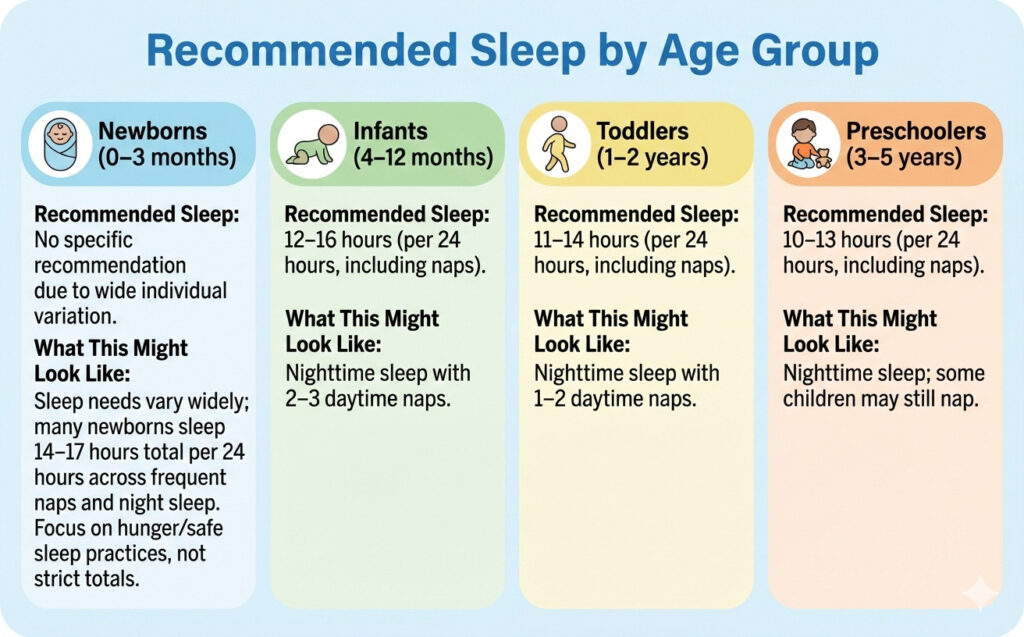
Keep in mind, these are ranges. Your child may fall on the higher or lower end and be perfectly healthy. What matters most is that he or she is getting enough rest to wake up refreshed and ready to explore. Building these healthy habits now helps prepare your child for the transition to school, when consistent routines become even more important.
What Happens When Children Don’t Get Enough Sleep
We’ve all seen what a missed nap can do. But when not getting enough sleep becomes a pattern, the results can build into more than a cranky afternoon.
Children who regularly fall short on sleep may have emotional outbursts that go beyond toddler tantrums. They may struggle to pay attention, have trouble remembering things they’ve learned, and find it harder to manage frustration. Over time, ongoing short sleep is associated with higher risks for obesity, weakened immunity, and behavioral challenges that can look like—or worsen—developmental delays (PMC review article).
If your child seems unusually irritable, hyperactive, or has difficulty learning despite your best efforts, sleep may be a factor worth looking into.
Practical Strategies for Building Healthy Sleep Habits
The good news is, healthy sleep habits can be built with simple, consistent strategies. You don’t need expensive equipment or a complicated plan—just a little patience and routine. The Sleep Foundation recommends these approaches:
Create a Consistent Schedule
Try to keep bedtime and wake time the same every day, even on weekends. A predictable schedule helps set your child’s internal clock, making it easier to fall asleep and wake up naturally. It doesn’t have to be exact to the minute. Close is close enough.
Establish a Calming Bedtime Routine
A 20- to 30-minute wind-down routine signals to your child’s body that sleep is on the way. This might include a warm bath, putting on pajamas, reading a favorite book, or singing a quiet song. The key is keeping the routine the same each night so your child knows what to expect. You can think of it as their body getting in rhythm with the ritual.
Limit Screen Time Before Bed
The bright, engaging screens keep little minds alert and active when they should be winding down. Turn off screens at least one hour before bedtime and keep devices out of the bedroom. A board book or a stuffed animal makes a much better bedtime companion than a tablet.
Encourage Daytime Activity
Active play during the day: tummy time for infants, crawling and climbing for toddlers. This helps children sleep more deeply at night. Just try to avoid high-energy play close to bedtime, as it can be more stimulating than calming.
Create the Right Sleep Environment
Keep the bedroom cool (around 65°F), dark, and quiet. A white noise machine can help mask household sounds. Comfortable, safe bedding appropriate for your child’s age makes a difference too. And of course, always follow safe sleep guidelines from the AAP, including placing infants on their backs to sleep.
Watch for Sleep Cues
Rubbing eyes, yawning, getting fussy or clingy behavior. These are your child’s way of saying, “I’m ready for sleep.” Putting your child down when you notice these cues, rather than waiting until he or she is overtired, often leads to easier and faster sleep.
Sleep Challenges in Children with Developmental Delays
Sleep problems are significantly more common in children with developmental differences, and the relationship often goes both ways. Poor sleep can make daytime challenges worse, while developmental traits can make it harder to fall and stay asleep.
Studies, including those referenced by the Autism Research Institute, indicate that 40 to 80 percent of children with autism spectrum disorder experience chronic sleep problems.
This includes difficulty falling asleep, frequent nighttime awakenings, and less time spent in the deep, restorative stages of sleep. Children with ADHD often deal with delayed sleep onset, restless nights, and frequent awakenings as well (Autism Speaks).
These challenges can come from a number of sources: sensory sensitivities that make the bedroom environment uncomfortable, anxiety or difficulty with transitions, and other co-occurring conditions.
The Impact on Daily Life
When children with developmental delays don’t sleep well, parents often notice that daytime symptoms get worse. Hyperactivity increases. Meltdowns happen more often and last longer. Learning becomes more of a struggle. It can feel like a cycle that’s hard to break without the right support.
Strategies That Can Help
If your child has developmental differences and sleep is a struggle, here are some approaches worth trying:
- Visual bedtime schedules. A picture-based routine chart helps children who struggle with transitions understand what comes next and feel more in control of the process.
- Sensory-friendly sleep environment. If your child is sensitive to textures, try soft, tagless pajamas and smooth bedding. Blackout curtains, white noise, or a weighted blanket (when age-appropriate and safe) can help children who are easily overstimulated settle down for the night.
- Gradual adjustments. Rather than making big changes all at once, shift bedtime by 10 to 15 minutes at a time. Small, steady steps work better than dramatic overhauls.
- Rule out medical causes. If sleep problems persist, your pediatrician may recommend a sleep study to check for conditions like sleep apnea that could be part of the picture.
Most importantly, know that help is available. Early intervention therapists can work with your family to address sleep-related challenges as part of a comprehensive treatment plan.
When to Seek Support
Every child has rough nights from time to time, and that’s perfectly normal. However, it’s worth reaching out to your pediatrician or early intervention team if you notice:
- Ongoing difficulty falling or staying asleep that affects your child’s mood or behavior during the day
- Frequent nighttime awakenings beyond what’s typical for your child’s age
- Loud snoring, gasping, or pauses in breathing during sleep
- Excessive daytime sleepiness or irritability despite what seems like enough sleep
- Sleep problems that seem to be making other developmental concerns worse
Trust your instincts. You know your child best. If something about their sleep doesn’t feel right, that’s reason enough to start a conversation with their doctor.
Early Intervention Therapies
If you have questions about your child’s sleep patterns, TEIS Early Intervention can help. Our specialists listen to your concerns, assess your child’s individual needs, develop a customized treatment plan, and coach you through simple, routine-based solutions to help your child thrive.
Call us at 412-271-8347 or ask your pediatrician about getting an Early Intervention evaluation.
Early intervention evaluations and therapy services are available under the Federal Early Intervention Program for Infants and Toddlers with Disabilities. Before services can begin, an independent evaluation of your child must be completed. To ensure impartiality, one agency provides evaluation services while another offers therapeutic services.
To schedule an evaluation, call 1-800-692-7288 or email help@connectpa.net
 Send to a friend!