
Communication Milestones and the Holidays
December 7, 2025
Sleep and Childhood Development: What Parents Should Know
February 9, 2026
Indoor Activities That Build Development:
Gross Motor, Cognitive, and Social Skills
Keeping toddlers active during winter months can be a challenge. Even adults can feel shut in when the days grow short and the temperature drops.
The good news? Your home already contains everything you need for fun activities with toddlers in January and February.
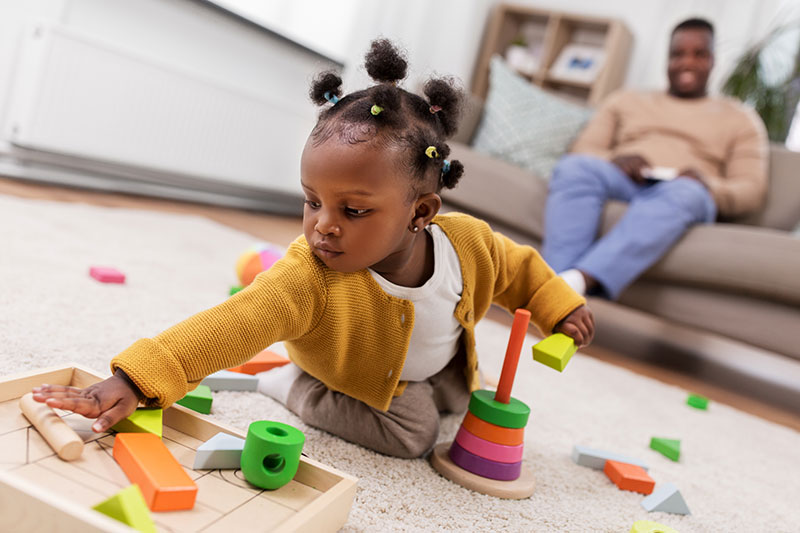
While the outdoor adventures of spring and summer offer unique benefits like varied terrain, fresh air, and exposure to nature, creative indoor activities can still support many of the same developmental skills: gross motor strength and coordination, cognitive problem-solving, and social-emotional growth.
Let’s take a look:
Why Indoor Play Matters for Development
Children ages 0-3 learn through movement and exploration. According to the American Academy of Pediatrics, active play supports crucial developmental milestones through physical fitness, sensory stimulation, social interaction, and cognitive growth. When outdoor play isn’t possible, bringing that same energy indoors keeps development on track.
Think of indoor play as an opportunity. Your home is a familiar environment where you can observe how your child moves, solves problems, and interacts with others. These everyday moments reveal important information about their developmental progress. Remember, the power of play is essential to your child’s health and development.
Three Domains, One Play Session
Child development experts focus on three key areas during the early years:
Gross Motor Development involves the large muscles used for crawling, walking, climbing, and jumping. These skills build core strength, balance, coordination, and body awareness.
Cognitive Development includes problem-solving, cause-and-effect understanding, memory, and concepts like patterns and classification.
Social-Emotional Development covers sharing, turn-taking, emotional regulation, and the relationship skills that form the foundation for social success.
The best indoor activities engage all these areas at once. A simple obstacle course builds strength; a sorting game develops cognitive skills; and a blanked fort provides fun social interaction.
1. Pillow Obstacle Courses: Building Strength and Coordination
A fun obstacle course can transform your living room into a developmental playground: stack couch cushions for climbing, line up pillows for jumping, and drape a blanket over chairs to create a tunnel for crawling.
What it strengthens: Climbing over cushions strengthens core muscles. Jumping between pillows improves balance and coordination. Crawling through tunnels develops motor planning. These activities support key gross motor milestones, such as pulling to stand (typically by 9–12 months), independent walking (often by 12–18 months), and running or climbing stairs with support (common by age 2).
Age adjustments: For younger toddlers (12-18 months), keep it simple with a basic crawling path and soft landing zones. For older toddlers (2-3 years), add challenges like tossing a ball into a laundry basket at the finish line or following a sequence of movements you call out.
What you need: Couch cushions, pillows, blankets, chairs, and a laundry basket.
For more examples, check out “7 Fun Indoor Toddler Activities” on the TEIS website.
2. Sorting Games: Early Math Through Play
Dump out a laundry basket and ask your toddler to help sort socks by color. Gather plastic kitchen utensils and group them by type. Match container lids to their bottoms. These simple activities introduce powerful cognitive concepts.
What it builds: Sorting develops classification skills and pattern recognition, the building blocks of early math. When your child groups red socks together, they’re learning that objects can share certain qualities. When they arrange bowls from smallest to largest, they’re exploring sequencing. These cognitive foundations support later learning.
Age adjustments: For younger toddlers, start with matching identical items like pairs of socks. By 18-24 months, introduce sorting by one attribute such as color. For children approaching age 3, try sorting by multiple attributes or creating simple patterns.
What you need: Laundry, plastic containers with lids, child-safe kitchen utensils, or any household items that can be grouped.
For more examples, check out “Home-Based Activities for Fine Motor Skill Development” on the TEIS website.
3. Blanket Fort Adventures: Problem-Solving and Imagination
Drape blankets over chairs, tables, or couch cushions to create an enclosed space. What happens inside that fort is up to your child’s imagination, but the building process itself is fun and challenging.
What it builds: Fort building is problem-solving in action. How do you make the blanket stay up? What happens when it falls? Children learn cause-and-effect as they experiment with different structures. Once inside, pretend play flourishes. The fort becomes a castle, a cave, a spaceship. This imaginative play develops narrative thinking and creative problem-solving.
Age adjustments: For younger toddlers, build the fort yourself and focus on the crawling in-and-out experience. For older toddlers, involve them in construction and encourage storytelling about their fort adventures.
What you need: Blankets, sheets, chairs, couch cushions, and pillows for comfort inside.
To learn more about the development of imagination and pretend play, check out “Cognitive Skill Developments Between 18 and 24 Months” on the TEIS website.
4. Hallway Bowling: Learning to Take Turns
Line up empty plastic bottles or cans at the end of a hallway. Roll a soft ball to knock them down. That’s a simple setup with great learning opportunities.
What it builds: While bowling develops gross motor skills like aiming and throwing, its real strength is social-emotional learning. Taking turns teaches patience. Watching a sibling or parent take their turn builds anticipation and emotional regulation. Cheering for someone else’s success develops empathy and positive social interaction. These simple relationship skills matter for later social success.
Age adjustments: For younger toddlers, sit close to the pins and focus on the rolling motion. Keep turns short. For older toddlers, add distance, introduce simple scorekeeping, and encourage them to reset the pins themselves.
What you need: Empty plastic bottles or lightweight cans, a soft ball or rolled-up socks.
For more examples, check out “Activities for Developing Motor Skills,” on the TEIS website.
5. Dance Parties: Movement, Bonding, and Emotional Expression
Turn on music and move. It’s that simple. Dance parties combine physical activity with emotional connection.
What it builds: Dancing develops balance, coordination, and body awareness as children learn to move to rhythm. Dancing together creates shared joy. Eye contact and mirrored movements strengthen family bonding. For toddlers, dancing can redirect energy and help with emotional regulation. Music itself supports language development through rhythm and repetition.
Age adjustments: For younger toddlers, hold them while you dance or sit together and clap along. For older toddlers, try freeze dance (stopping when the music stops) to add cognitive challenge, or action songs like “Head, Shoulders, Knees, and Toes” that combine movement with learning.
What you need: Music and a little floor space. That’s it.
For more examples, check out “The Power of Musical Play in Early Development” on the TEIS website.
Making Indoor Play Work for Your Family
The beauty of these activities is how simple they are. A five-minute dance break between meals counts. Sorting socks while folding laundry turns a chore into a learning moment. Building a quick cushion mountain before bath time gets out extra energy.
Follow your child’s lead. If they want to knock down the bowling pins without waiting for turns, that’s developmentally appropriate for younger toddlers. If they’d rather sit inside the blanket fort than help build it, let them. The goal is a few moments of engaging fun, not perfection.
Remember, your participation transforms play from entertainment into connection. And that connection is where the deepest learning happens.
When to Talk to Your Pediatrician
One of the most important things to remember is that every child develops at their own pace, and there’s a wide range of normal. These indoor activities give you natural opportunities to observe your child’s development in action. While playing, you might notice strengths you hadn’t seen before or areas where your child needs more support.
Consider talking with your pediatrician if you notice:
- Difficulty with basic movements like crawling or walking by expected ages
- Little interest in exploring toys or household objects
- Limited response to your interactions during play
- Consistently avoiding certain types of play or movement
Trust your instincts. You know your child best. If something feels off, there’s never any harm in asking questions. Early support makes a real difference, and getting answers brings peace of mind.
Early Intervention Therapies
If you have questions about your child’s development during these fun, in-home activities, TEIS Early Intervention can help. Our specialists listen to your concerns, assess your child’s individual needs, develop a customized treatment plan, and coach you through simple, routine-based solutions to help your child thrive.
Call us at 412-271-8347 or ask your pediatrician about getting an Early Intervention evaluation.
Early intervention evaluations and therapy services are available under the Federal Early Intervention Program for Infants and Toddlers with Disabilities. Before services can begin, an independent evaluation of your child must be completed. To ensure impartiality, one agency provides evaluation services while another offers therapeutic services.
To schedule an evaluation, call 1-800-692-7288 or email help@connectpa.net
 Send to a friend!